We've all felt the massive shift AI is creating in our culture. We are at a very unique point, as technology has given us capabilities that seemed science fiction to previous generations. One of the insights I'm noticing in this massive shift over the last decade or more is that we are moving from general information and averages to hyper-specific, context-driven information. AI isn't just changing one thing; it's changing everything. At the same time, it's created a future that seems more aligned to the past than the present.
Averages and generalized products, goods, and services became the standard for growth and scale during the Industrial Revolution and boomed with mass media and marketing post WWII. It’s what made scaling possible and incredibly profitable. Prior to that, most business was personal, specific, and local. Generalization enabled businesses to achieve unprecedented scale. Now, AI is combining both worlds, moving us toward hyper-personalized/specific at scale.
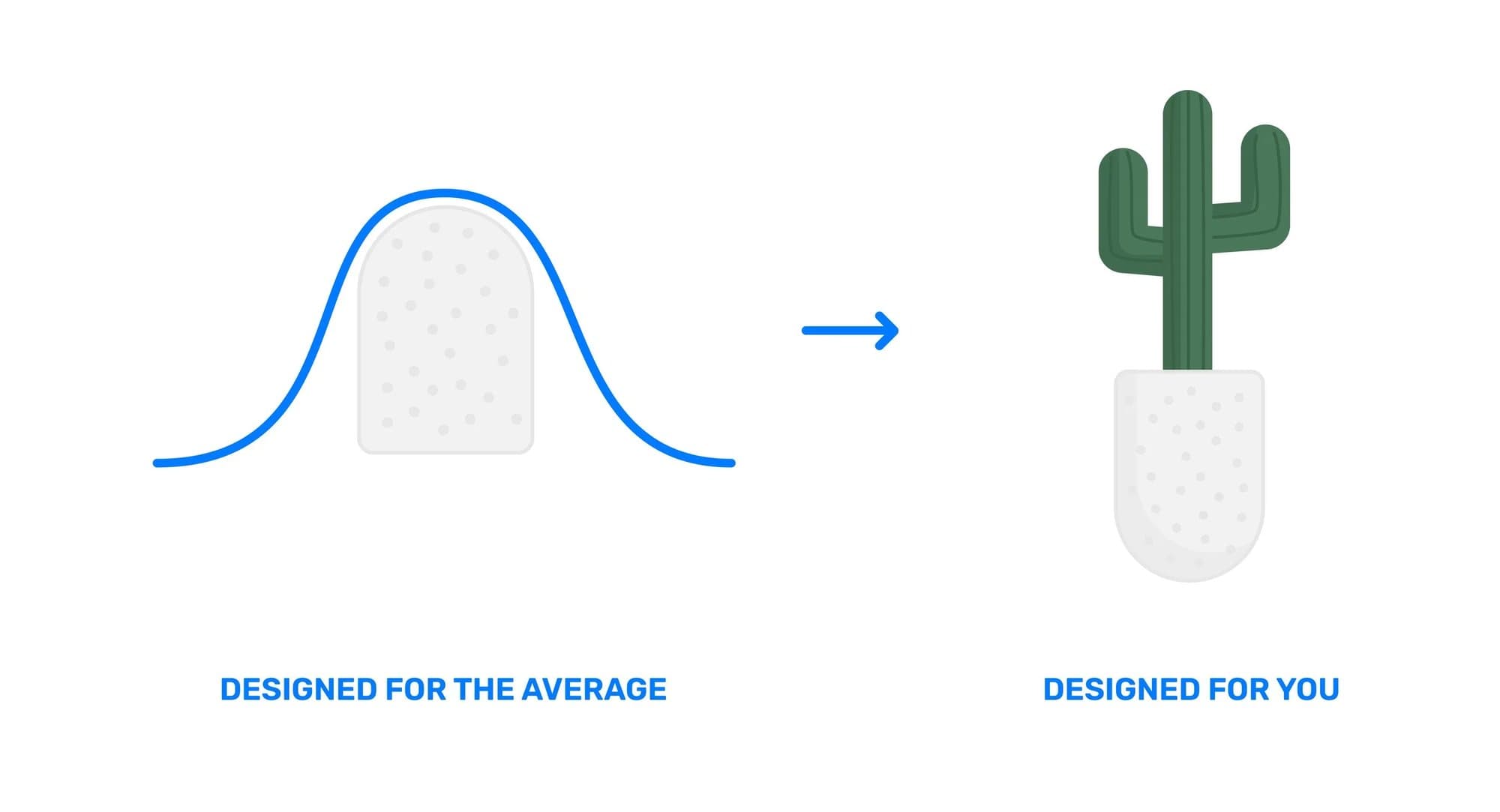
The important takeaway isn’t about abandoning systems but rather re-humanizing our companies and cultures. We have gained clarity that the objective was never about finding mass averages that scale; that was just limitations of extractive systems/economics. It’s been about finding value and solving problems for individuals. AI is opening a brand-new way to craft hyper-specific systems/economics at scale.
The History: The Rise of Average
Industrial Revolution: Standardization for efficiency; the birth of “the average”
We have to look back in order to look forward and understand what made the rise of “the average” and generalization so dominant. It grew out of the Industrial Revolution, when increased production and efficiency created a need for standardization. Even concepts of workdays and the “40-hour work week” emerged from broader societal and cultural shifts to support the unparalleled scale of production and profit. It transformed our economy and our minds. This complete social and mental evolution seems to parallel the rise of AI in modern times, as it is rewriting how society functions and how work is organized and executed.
During the Industrial Revolution, scale, efficiency, predictability, and generalization became the obsessive driver. Where custom boutiques made bespoke products and services for the individual, companies looking to scale began seeking commonality and groupings. Clothing sizes changed to (S, M, L) to hit 80% of the middle population. Manufacturing plants began designing work environments for the “average man,” enabling companies to view people as replaceable resources. This created a culture that, for the most part, still shapes how most companies operate today.
Post-WWII Mass Media (1950s–1970s): Mass marketing, archetypes, and the rise of consumerism
So while the Industrial Revolution laid the foundation, it was the post WWII mass media and marketing boom that calcified generalizations. Marketing began using these grouping details, like demographics, archetypes, wages/salaries, mixed with storytelling to drive predictability and scale through the rise of consumerism. Again, this removed the personal connection. It became “keeping up with the Joneses.” There was also a growing need to unify the US on information, such as news, warnings, national updates, broadcasts, and advancements, so this was about generalizing information or messaging for all US citizens.
Cable & Early Internet (1980s–2000s): More channels, early personalization, and democratized voices
General messaging was part of what drove the rise of cable and the early internet. It wasn’t just about people not feeling heard. You start to see youth and young adults (who were mostly ignored because they were not part of “the working group,” therefore not of interest to a business) disconnecting from general messaging and valuing smaller uniques voices. Shows like MTV helped introduce the idea of personalization and democratized voices. The internet exponentially expanded on that desire, and you see people expanding their world through digital connections.
Social Media Era (2010s): From mass to “my feed,” personalization, and authenticity
The era of mobile and social media completely reshaped our minds and cultures world wide, and we moved from mass media to personalized media. It was no longer about more voices but about building your own network of voices. Marketing messaging and media platforms started using this data to refine their approaches and move from general to personal. It was no longer about being like a celebrity but about becoming an “every-day influencer”. Since 2019, we have seen a major shift in focus from likes and follows to algorithms refined for common interests. Over the past 8 years, we have seen media platforms move from social media to interest media.
The Present: The Hyper-Specific Shift
We now sit in an impactful moment in time. We have spent the last several decades generating immense amounts of data that power AI systems. As these AI tools are built out, companies can begin crafting experiences and products fine-tuned to individuals, rather than aimed at mass adoption. The shifts we have seen in the last 40-50 years, mixed with AI as a foundational general-purpose technology unlocks new levels of design capability.
This isn’t “out there in the future.” This is happening now. There are many emerging signals showing this shift. It’s not about wanting to buy a celebrity’s scent; now, with companies like Everyhuman or OlfactoryNYC, you can create custom, personal scents crafted just for you. Another example is in hair and skin care. The company Prose will use your data to craft products for individuals. On their website, they say, “ We’ll analyze 80+ factors—from what you eat to where you live—to understand the unique needs of your hair and skin.” Now imagine these brands and products either grow with you or introduce you to new products/brands when you have outgrown their offering. In this scenario, B2B connections start to look more like a friend group than competitors. It could shift to how brands not only work with you but also work with other brands in your personal circle.
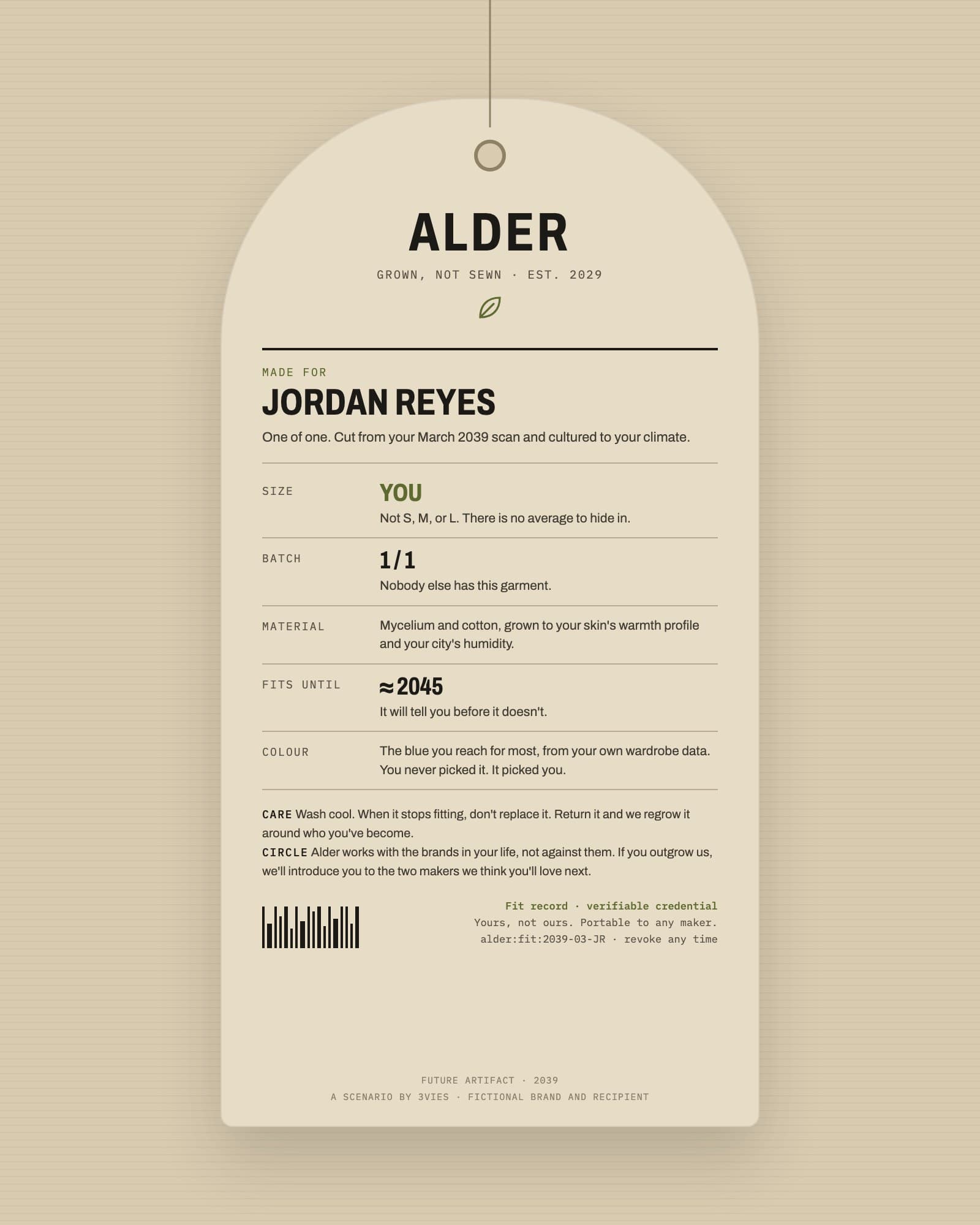
To feel what that could look like, I designed a future artifact: a clothing hang tag from 2039, from a fictional maker called Alder. The size reads “you.” The garment is grown for one person’s body and climate, tells them before it stops fitting, and when they outgrow it, Alder introduces them to the next makers they’ll love. Brands working with you, and with each other.
Medicine is another example. The future of medicine is less about what works for everyone and more about crafting treatments tailored to individual gnomes and specific body functions. Looking forward, it is moving from “what's right for most” to “what's right for this body at this time.” Therapies can be designed to lessen side effects, rather than accepting them as a “necessary evil.”
Perhaps the biggest insight is the importance of people learning to navigate choice rather than accept the general. When the world is no longer designed for the average, you can’t hide in the general. Knowing ones own self is no longer a nice-to-have but a necessity in navigating this post-general era. We need to realize that technology is becoming an incredibly powerful mirror, revealing deeper parts of ourselves.
Personal Legends : Flourishing Beyond Self
Now, this section may sound idealistic, but stick with me for a minute. My focus here isn’t on sharing emerging trends or signals of change with the general public. Keeping with the topic of moving from general to specific, I wanted to talk directly about individual awakening and the journey of finding meaningful fulfilment in your life. In the story The Alchemist, it’s described as ones ‘Personal Legend.’ Many people will live their entire life without ever feeling peace of truely seeing themselves. The lure of mass marketing has lost its appeal. Instead, people are looking for deep, impactful connections in close circles.
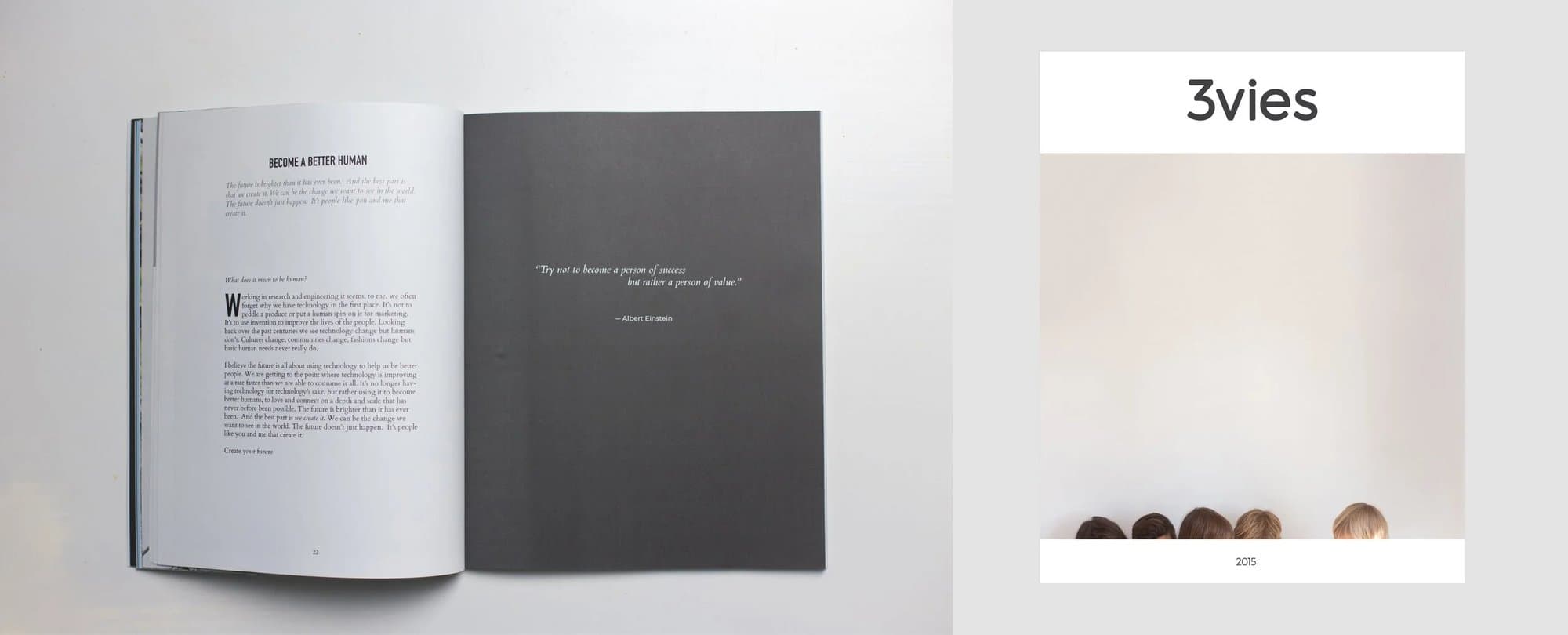
This is what it means to flourish. You stop seeking outward and instead discover that meaning is embedded within.As we move to a world tailored to you, it's imperative that we remain curious. Curious about ourselves, about the future, or about what we thought we knew. Never lose the gift of personal exploration. Keep your mind fixed on uncovering the deeper sides of yourself. When we remember that “everyone you meet is a mirror the good you see me already resides in you that's how you're able to see it” (3vies Volume 36). Thats how we are able to see ourselves. AI is another mirror. It is exposing new sides of humanity, both individually and collectively. I’m curious to see what more we can uncover about ourselves.
There seems to be a mental maturation as an individual begins to wake up to life and look beyond the meaningless noise. We shift our minds from titles to people and spaces we desire to nourish. Not for the money, fame, or recognition, but for the internal peace and personal convictions. The role of nurturer has always been viewed as soft, but I am starting to realize it is powerful and full of endlessly expansive love. That energy moves us from success to a lasting legacy. It’s using our time in life to build systems of energy that can nourish the people and ideas that touch our souls long after we’re gone.
Caution: Losing The Collective We
We need to be careful not to lose the collective 'we' as we make this shift in their hyper-specific. With all these systems primarily focused on serving individuals, we, as individuals, need to create spaces that connect us as humans. The rise of this post-general era needs to coincide with what I discussed in my paper on future value exchange, highlighting the culture shift that's also happening, moving us toward nourishing spaces. It's about creating a culture of connectedness, meaning when I win, you win, and when you win, we win. If we lose that, then all the data in the world won't help us see past ourselves.
We also need to be careful we don’t loose ourself in the mirror as well (the mirror being AI). We’ve already seen people get wrapped up in their own delusions. In this post-general era, the need for personal grounding doesn’t disappear; it becomes essential. There’s an increased risk if we fail to integrate this grounding into our own lives. Ultimately, perhaps our greatest influence comes from mastering self-control.
Conclusion: Embracing the Post-General Journey
Let’s first acknowledge that we are living through a time of massive ambiguity, and that the pace of change is faster than any one person can keep up with, and that there is more choice than at any previous moment in history. This is why I talk so much about the power of learning how to live life intentionally. In this moment of seemingly unlimited choice and power of action, none of it matters if you don’t really understand yourself. Intentional living is about discovering what you believe, learning to trust/communicate with your deepest core self, and building or updating your own systems for navigating life.
We are entering a time when systems will have more data and influence over each individual than ever. Knowing ones own self is no longer a nice-to-have but a necessity in navigating this post-general era. As I mentioned before, the objective was never about finding mass averages that scale; it’s always been about finding value through solving problems for individuals, both visible and those hidden inside generalized groups. AI is opening a brand-new way to craft hyper-specific systems and economics at scale. This next era is on us, as individuals, to define our own meaning and decide what we want to nourish in the world.